3 Cartridge Filter Housing: Complete Selection, Sizing and Application Guide
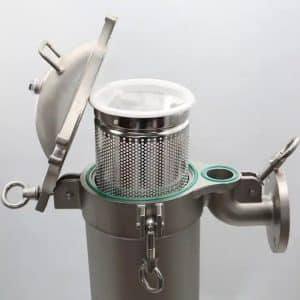
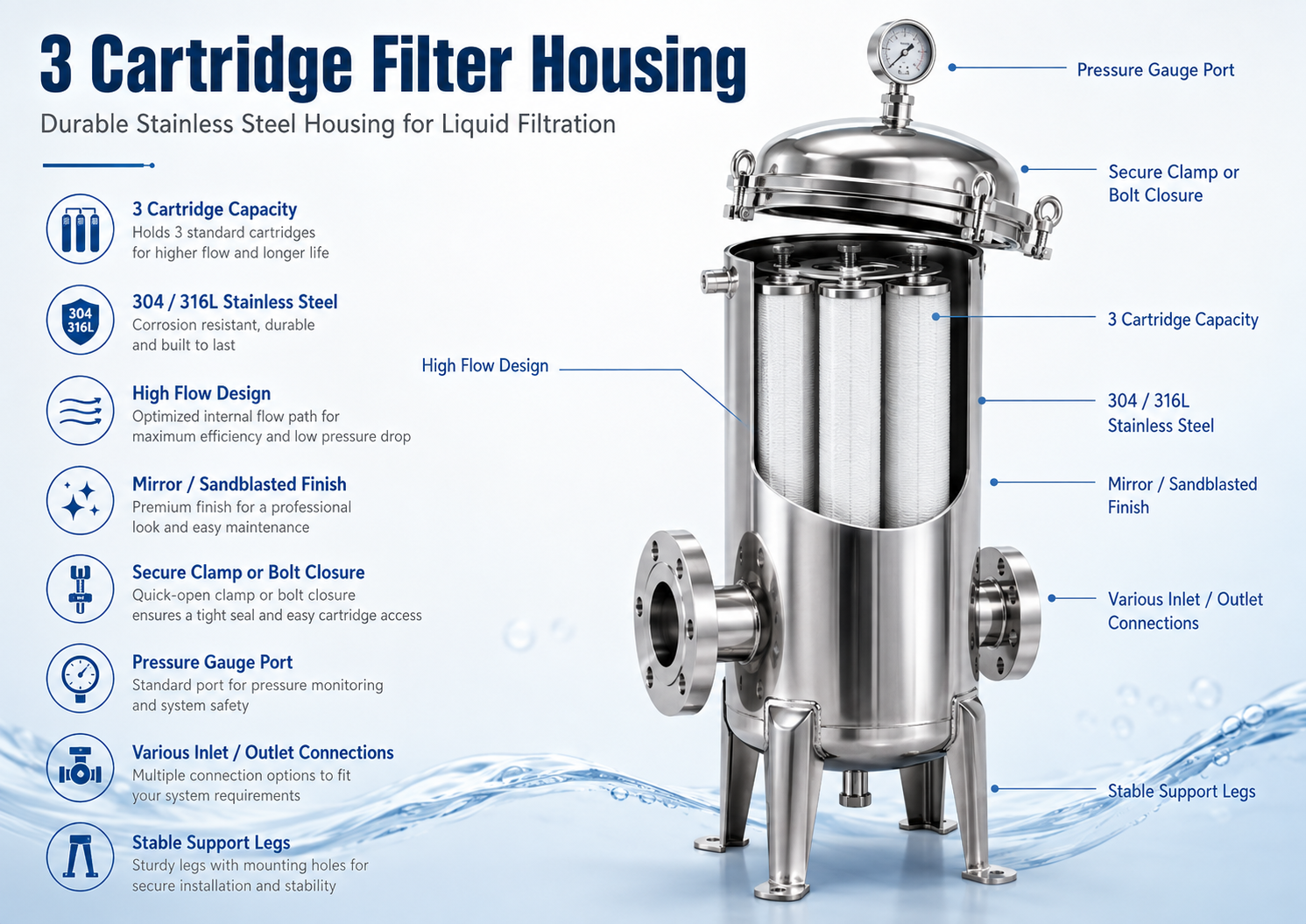
A 3 cartridge filter housing is an industrial pressure vessel designed to hold three replaceable filter cartridges in parallel.
Compared with a single- or two-cartridge housing, a 3-round design provides more filtration area, higher potential flow capacity and greater contaminant-holding capacity while remaining considerably more compact than large multi-cartridge vessels.
This makes three-cartridge filter housings a practical choice for small and medium industrial liquid filtration systems, including:
- Industrial water treatment
- RO pretreatment
- Food and beverage processing
- Chemical filtration
- Paint and coating production
- Cooling water filtration
- Process water filtration
- Pharmaceutical water treatment
- Pre-filtration and final polishing
The housing can be manufactured in different materials, cartridge lengths, pressure ratings and connection configurations according to the filtration process.
What Is a 3 Cartridge Filter Housing?
A 3 cartridge filter housing, also known as a 3-round cartridge filter housing, contains three filter cartridges installed vertically inside one pressure vessel.
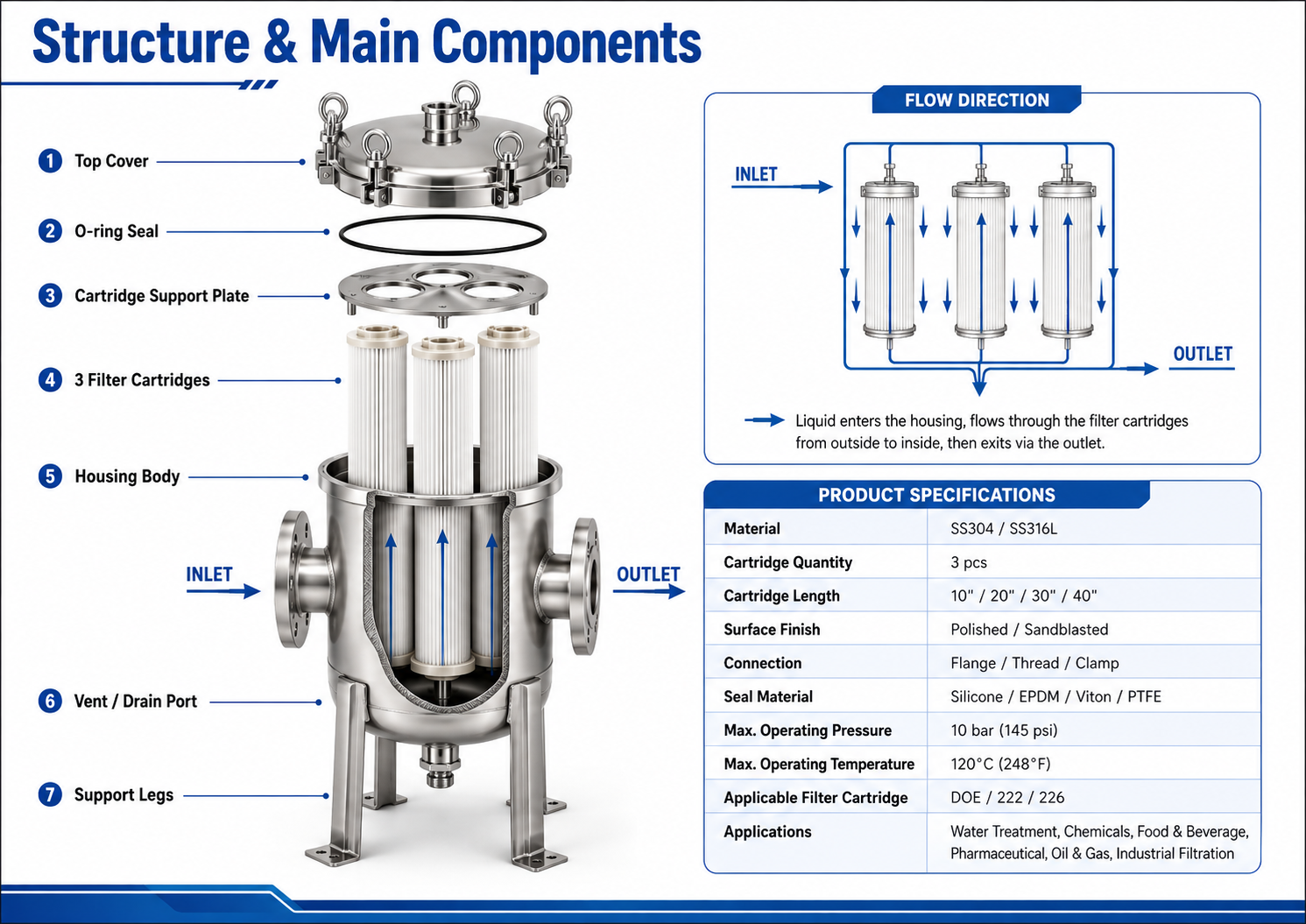
In most conventional designs, unfiltered liquid enters the housing and is distributed around the three cartridges.
The liquid then passes through the filter media, where suspended particles and other contaminants are captured.
The filtered liquid collects in the clean side of the housing and exits through the outlet.
The three cartridges normally operate in parallel rather than in series.
Therefore:
Total System Flow ≈ Flow Through Cartridge 1 + Cartridge 2 + Cartridge 3
This configuration increases available filtration area without requiring three separate filter housings.
Why Use Three Filter Cartridges?
The primary reason for using three cartridges is to increase the effective filtration area available to the process.
Suppose a selected cartridge is recommended to operate at approximately 3 m³/h under the required filtration conditions.
If your process requires:
9 m³/h total flow
the theoretical distribution would be:
9 m³/h ÷ 3 cartridges = 3 m³/h per cartridge
A three-cartridge housing could therefore be a logical starting point.
However, this should only be treated as an initial sizing calculation.
Actual cartridge capacity depends heavily on:
- Cartridge construction
- Filter media
- Cartridge length
- Micron rating
- Liquid viscosity
- Solids concentration
- Temperature
- Initial pressure drop
- Maximum allowable differential pressure
For reliable sizing, the housing and cartridges should always be evaluated as one filtration system.
Main Advantages of a 3 Cartridge Filter Housing
1. More Filtration Area
Three cartridges provide approximately three times the cartridge quantity of a comparable single-round housing.
More available filtration area can reduce the loading placed on each cartridge.
This is especially useful when filtration capacity is limited by pressure drop or contaminant loading.
2. Higher Potential Flow Capacity
Because the process flow can be distributed across three cartridges, a 3-round housing generally handles greater flow than an equivalent single-cartridge configuration using the same cartridge technology.
However, flow capacity should never be determined by cartridge quantity alone.
3. Lower Loading Per Cartridge
At the same total system flow, increasing the number of cartridges decreases the flow passing through each individual filter element.
For example:
| Housing | Total Flow | Approx. Flow per Cartridge |
|---|---|---|
| 1 cartridge | 9 m³/h | 9 m³/h |
| 2 cartridges | 9 m³/h | 4.5 m³/h |
| 3 cartridges | 9 m³/h | 3 m³/h |
Lower loading can help reduce differential pressure and improve cartridge utilization.
4. Longer Filter Change Intervals
A larger total filtration area normally provides more available contaminant-holding capacity.
Depending on feed-water quality and cartridge design, this may reduce cartridge replacement frequency.
For plants operating continuously, longer filter cycles can reduce:
- Maintenance labor
- Production interruptions
- Cartridge consumption
- Filter disposal
- Overall filtration cost
5. Compact Alternative to Larger Multi-Round Housings
A 3 cartridge filter housing is often useful when a two-cartridge housing is no longer sufficient but a 5-, 7-, 12- or larger multi-cartridge vessel would be oversized.
It therefore occupies an important position between compact and high-capacity industrial filtration systems.
How to Select a 3 Cartridge Filter Housing
Correct housing selection should begin with the process conditions.
The following factors should be confirmed before specifying the vessel.
1. Required Flow Rate
Start with the actual process flow.
You should identify:
- Normal operating flow
- Maximum flow
- Peak flow
- Future expected flow
An initial cartridge quantity can be estimated using:
Number of Cartridges = Required System Flow ÷ Recommended Flow per Cartridge
For example:
Required flow = 12 m³/h
Recommended cartridge flow = 4 m³/h
Therefore:
12 ÷ 4 = 3 cartridges
A three-round housing may be suitable.
But the calculation must then be checked against expected pressure drop, fluid characteristics and contaminant loading.
Important
Do not assume that every 3 cartridge filter housing has the same flow rating.
A housing containing three 40-inch pleated cartridges may perform very differently from a housing containing three 10-inch melt-blown cartridges.
2. Choose the Cartridge Length
Common industrial cartridge lengths include:
- 10 inch
- 20 inch
- 30 inch
- 40 inch
Some specialized systems may also use longer elements.
3 × 10-Inch Cartridge Housing
Usually suitable for:
- Lower-flow applications
- Compact installations
- Point-of-use filtration
- Small process systems
3 × 20-Inch Cartridge Housing
Provides more filtration area while maintaining a manageable equipment height.
Often used for:
- Commercial water treatment
- Small industrial systems
- Process water
- RO pretreatment
3 × 30-Inch Cartridge Housing
Suitable when greater filtration area and longer service intervals are required.
Common applications include:
- Beverage processing
- Industrial water treatment
- Chemical filtration
3 × 40-Inch Cartridge Housing
Provides considerably more filtration area than a 3 × 10-inch configuration.
It can be useful when:
- Flow requirement is higher
- Cartridge replacement frequency needs to be reduced
- Equipment diameter needs to remain relatively compact
The final choice should consider both filtration capacity and available installation height.
3. SS304 vs SS316L Filter Housing
Stainless steel is one of the most common materials for industrial multi-cartridge filter housings.
SS304 Cartridge Filter Housing
SS304 is widely used for:
- Industrial water
- Process water
- Cooling water
- RO pretreatment
- General non-aggressive liquids
Advantages include:
- Good corrosion resistance
- Good mechanical strength
- Long service life
- Competitive cost
For many standard water filtration applications, SS304 provides an effective balance between performance and price.
SS316L Cartridge Filter Housing
SS316L provides improved corrosion resistance and is commonly selected for more demanding applications.
Typical uses include:
- Food processing
- Beverage production
- Pharmaceutical water
- Chemical processing
- High-purity water
- Corrosive process liquids
- Certain higher-chloride environments
SS316L should not automatically be considered compatible with every chemical.
The liquid composition, concentration, temperature and cleaning chemicals must still be reviewed before final material selection.
4. Select the Correct Cartridge Type
The filter housing is only one part of the filtration system.
The installed filter cartridge determines much of the actual filtration performance.
A three-cartridge housing may be designed for different filter elements.
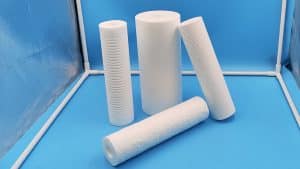
Melt Blown Filter Cartridges
Commonly manufactured from polypropylene.
Suitable for:
- Sediment filtration
- Process water
- RO pretreatment
- General industrial filtration
Typical advantages include economical cost and depth-filtration capability.
String Wound Filter Cartridges
Manufactured by winding filtration yarn around a central core.
Suitable for:
- Industrial process liquids
- Water filtration
- Chemical processing
- Higher solids loading
Different yarn and core materials can be selected according to chemical and temperature requirements.
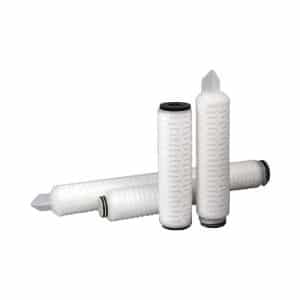
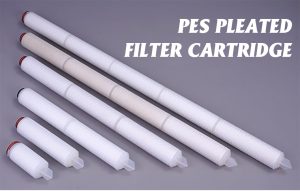
Pleated Filter Cartridges
Pleated construction provides a large filtration area in a compact cartridge.
Applications include:
- Fine filtration
- Process water
- Food and beverage
- Chemical filtration
- High-purity filtration
Membrane Filter Cartridges
Used where higher filtration precision or microbial control is required.
Common membrane materials include:
- PES
- PTFE
- PVDF
- Nylon
- Polypropylene
Stainless Steel Filter Cartridges
Useful for applications requiring:
- High temperature resistance
- Mechanical strength
- Washability
- Reusable filtration elements
5. DOE, 222 or 226: Which Cartridge Connection Is Better?
The cartridge end configuration must match the internal design of the filter housing.
DOE – Double Open End
DOE cartridges are open at both ends.
They are commonly used for general industrial filtration.
Typical DOE cartridges include:
- Melt blown cartridges
- String wound cartridges
- Pleated cartridges
- Carbon cartridges
DOE designs are popular because replacement elements are widely available and relatively economical.
222 O-Ring
222 cartridges use double O-ring seals.
They provide a more positive sealing arrangement and can help minimize bypass around the cartridge.
They are often used for:
- Fine filtration
- Food processing
- Pharmaceutical applications
- Membrane filtration
226 O-Ring
226 cartridges also use double O-rings, usually together with a locking or bayonet-style configuration.
They are commonly selected when a secure cartridge installation and positive seal are required.
Important Selection Rule
DOE, 222 and 226 cartridges are not automatically interchangeable.
The internal cartridge seat, adapter and sealing structure of the housing must match the cartridge end configuration.
6. Choose the Micron Rating
A common purchasing mistake is asking:
“What micron rating is this filter housing?”
The housing itself does not normally determine the filtration precision.
The filter cartridge determines the micron rating.
Depending on the cartridge design, available ratings may include:
- 0.2 micron
- 0.45 micron
- 1 micron
- 3 micron
- 5 micron
- 10 micron
- 20 micron
- 25 micron
- 50 micron
- 100 micron
The correct filtration rating should be selected according to:
- Contaminant particle size
- Downstream equipment requirements
- Product quality requirements
- Filtration stage
- Desired cartridge service life
A very fine cartridge should not automatically be selected simply because it appears to offer “better filtration.”
Using an unnecessarily fine micron rating can increase pressure drop and reduce service life.
7. Nominal vs Absolute Micron Rating
Industrial buyers should also understand the difference between nominal and absolute filtration ratings.
A nominal-rated cartridge removes a specified percentage of particles near its stated micron size.
An absolute-rated cartridge is designed to achieve a more precisely defined retention performance.
Exact definitions and efficiencies vary between manufacturers.
For critical processes, buyers should therefore request:
- Particle retention efficiency
- Beta ratio, where applicable
- Validation data
- Cartridge performance curves
rather than comparing products by micron number alone.
8. Check Operating Pressure
A cartridge housing is a pressure vessel.
Before selecting the housing, determine:
- Normal operating pressure
- Maximum working pressure
- Pump shut-off pressure
- Design pressure
- Maximum differential pressure
Do not select a housing based only on its cartridge quantity or connection diameter.
Maximum allowable pressure depends on:
- Housing material
- Wall thickness
- Closure design
- Temperature
- Manufacturing standard
- Applicable pressure-vessel code
For higher-pressure applications, always confirm the manufacturer’s approved pressure rating.
9. Check Operating Temperature
Temperature can affect:
- Housing strength
- Cartridge media
- O-ring material
- Chemical compatibility
- Pressure rating
Therefore, housing temperature resistance and cartridge temperature resistance must both be checked.
A stainless steel housing capable of handling the process temperature does not automatically mean the installed polypropylene cartridge or elastomer seal can tolerate the same conditions.
10. Select the Inlet and Outlet Connection
Common industrial connection types include:
- NPT thread
- BSP thread
- ANSI flange
- DIN flange
- Tri-Clamp
- Victaulic connection
- Welded connection
Typical connection selection depends on:
- Required flow
- Pipeline diameter
- Industry standard
- Sanitary requirements
- Installation method
Connection diameter is particularly important.
Even if three cartridges provide sufficient filtration area, an undersized inlet or outlet can restrict flow and increase system pressure loss.
11. Select the Correct Gasket or O-Ring
Common sealing materials include:
- EPDM
- NBR / Buna-N
- Silicone
- FKM / Viton
- PTFE
Seal compatibility depends on:
- Process liquid
- Chemical concentration
- Temperature
- Cleaning process
For chemical filtration, buyers should evaluate the compatibility of all wetted components:
Housing + cartridge + cartridge gasket + housing O-ring
3 Cartridge Filter Housing Applications
RO Pretreatment
Cartridge filters are widely used ahead of reverse osmosis systems.
The objective is to reduce particulate contamination before water reaches the RO membranes.
A three-cartridge configuration can be appropriate when a single- or two-round housing does not provide enough filtration area.
Industrial Process Water
Typical applications include:
- Plant process water
- Cooling water
- Rinse water
- Recycled water
- Utility water
- Boiler pretreatment
- Equipment protection
Food and Beverage Processing
With the correct sanitary construction, filter cartridges may be used for filtration of:
- Process water
- Beer
- Wine
- Juice
- Syrup
- Beverage ingredients
Food and beverage applications may require:
- SS316L construction
- Sanitary Tri-Clamp connections
- Hygienic internal design
- Suitable surface finishing
- Food-contact compliant seals
Chemical Filtration
Three-cartridge filter housings can be used to remove particulate contaminants from:
- Solvents
- Acids
- Alkalis
- Resins
- Process chemicals
- Cleaning fluids
Chemical compatibility must be confirmed before use.
Paint, Ink and Coating Filtration
Cartridge filtration helps remove:
- Agglomerates
- Foreign particles
- Process contamination
- Undesired solids
This can help protect downstream equipment and improve final product consistency.
Pharmaceutical and High-Purity Water
Sanitary cartridge housings can be used in high-purity water and pharmaceutical process filtration.
These applications may require additional consideration of:
- Surface roughness
- Drainability
- Cleaning
- Sterilization
- Material documentation
- Validation
2 Cartridge vs 3 Cartridge Filter Housing
One of the most common questions is whether to select two or three cartridges.
| Feature | 2 Cartridge Housing | 3 Cartridge Housing |
|---|---|---|
| Cartridge quantity | 2 | 3 |
| Filtration area | Medium | Higher |
| Potential flow capacity | Low-medium | Medium |
| Dirt-holding capacity | Medium | Higher |
| Housing size | Smaller | Slightly larger |
| Cartridge replacement cost | Lower | Higher |
| Typical application | Small systems | Small-medium industrial systems |
Choose a 2 cartridge filter housing when the required flow and contaminant load can be handled comfortably by two cartridges.
Choose a 3 cartridge filter housing when:
- Two cartridges create excessive pressure drop
- Greater flow is required
- Cartridge life is too short
- Solids loading is higher
- Future capacity expansion is expected
3 Cartridge vs 5 Cartridge Filter Housing
A 3-round configuration is not always the best choice.
If three cartridges are already operating near their maximum recommended flow, moving directly to a five-round or larger housing may provide better long-term economics.
Consider a larger housing when:
- Flow demand is expected to increase
- Contaminant loading is high
- Cartridge replacement is frequent
- Downtime is expensive
- Pressure drop must be minimized
- Longer maintenance intervals are required
Oversizing a cartridge housing moderately can sometimes reduce lifecycle filtration costs by extending cartridge service life.
However, excessively oversized equipment increases:
- Initial investment
- Equipment footprint
- Liquid hold-up volume
- Replacement cartridge quantity
The objective is therefore not to select the largest housing possible.
The objective is to select the correct filtration area for the process.
3 Cartridge Filter Housing vs Bag Filter Housing
Both technologies are widely used for industrial liquid filtration.
Cartridge Filter Housing
Usually preferred when:
- Finer filtration is required
- High filtration efficiency is important
- A broad selection of filter media is required
- Final polishing is necessary
Bag Filter Housing
Often preferred when:
- Solids loading is relatively high
- Coarser filtration is acceptable
- Large dirt-holding capacity is required
- Fast filter changes are important
In some industrial systems, the technologies are installed together:
Bag Filter → Cartridge Filter → Final Process
The bag filter removes larger contaminant loads, while the cartridge filter performs finer polishing.
3 Cartridge Housing vs High Flow Filter Housing
A traditional three-round housing uses multiple standard-diameter cartridges.
A high-flow filter housing generally uses a larger-diameter cartridge designed to handle significantly greater flow per element.
A traditional 3 cartridge housing may be preferable when:
- Standard cartridges are already used in the plant
- Replacement cartridge availability is important
- Flow requirement is moderate
- Multiple cartridge materials are required
A high-flow filter housing may be more suitable when:
- Flow rate is very high
- Reducing cartridge quantity is important
- Maintenance labor needs to be minimized
- A compact high-capacity system is required
How to Calculate Cartridge Quantity
A simplified initial calculation is:
N = Q ÷ q
Where:
N = Required cartridge quantity
Q = Total required system flow
q = Recommended operating flow per cartridge
For example:
System flow = 15 m³/h
Recommended cartridge flow = 5 m³/h
Therefore:
N = 15 ÷ 5 = 3 cartridges
A three-cartridge housing may be appropriate.
However, professional filter sizing should also consider:
ΔP = Pressure Drop
If the predicted initial differential pressure is too high, additional filtration area may be required even if the simple flow calculation suggests that three cartridges are sufficient.
What Causes High Pressure Drop in a Cartridge Filter Housing?
Excessive differential pressure can be caused by:
- Too much flow
- Insufficient cartridge area
- Very fine micron rating
- High liquid viscosity
- High contaminant concentration
- Incorrect cartridge selection
- Blocked cartridges
- Undersized piping
- Small inlet/outlet connections
Therefore, replacing the housing alone does not always solve a pressure-drop problem.
The complete filtration system should be evaluated.
When Should Filter Cartridges Be Replaced?
Cartridges should generally be replaced according to:
- Differential pressure
- Product quality requirements
- Validated operating procedure
- Maximum recommended service time
Monitoring inlet and outlet pressure allows operators to calculate:
Differential Pressure = Inlet Pressure − Outlet Pressure
When the differential pressure reaches the cartridge manufacturer’s recommended replacement limit, the cartridge should normally be changed.
Do not rely only on visual appearance.
Recommended Accessories for a 3 Cartridge Filter Housing
Depending on the system, useful accessories include:
Pressure Gauges
Installing gauges upstream and downstream makes it possible to monitor cartridge pressure drop.
Vent Valve
Allows trapped air to be released during startup.
Drain Valve
Makes housing drainage easier during cartridge replacement or maintenance.
Pressure Relief Device
May be required depending on system design and applicable safety requirements.
Adjustable Legs or Mounting Bracket
Useful for industrial installation and maintenance access.
Sanitary Connections
Tri-Clamp connections are commonly selected for hygienic processing systems.
What Information Should You Send When Requesting a Quote?
To receive an accurate quotation for a 3 cartridge filter housing, provide as much of the following information as possible:
- Process liquid
- Required flow rate
- Operating pressure
- Maximum pressure
- Operating temperature
- Required micron rating
- Cartridge material
- Cartridge length
- DOE, 222 or 226 configuration
- Housing material
- Inlet/outlet size
- Connection type
- Gasket material
- Required surface finish
- Application industry
- Required certification or pressure-vessel standard
If all specifications are not available, start with these five:
Liquid + Flow Rate + Micron Rating + Pressure + Temperature
These parameters allow a filter manufacturer to begin evaluating the appropriate housing configuration.
Frequently Asked Questions
What is a 3 cartridge filter housing?
A 3 cartridge filter housing is a pressure vessel containing three replaceable filter cartridges. The cartridges normally operate in parallel, increasing available filtration area compared with single- and two-cartridge housings.
Is a 3 cartridge filter housing the same as a three-stage filter?
No.
A three-cartridge housing normally uses three cartridges operating at the same filtration stage inside one vessel.
A three-stage filter uses multiple filtration stages in sequence.
For example:
50 μm → 10 μm → 1 μm
These are different filtration concepts.
What flow rate can a 3 cartridge filter housing handle?
There is no universal flow rating for every three-cartridge housing.
Flow depends on:
- Cartridge length
- Filter media
- Micron rating
- Liquid viscosity
- Contaminant loading
- Connection size
- Allowed pressure drop
Use the selected cartridge’s recommended operating flow to calculate required cartridge quantity.
Can three 40-inch cartridges be installed?
Yes, if the housing is specifically designed for three 40-inch cartridges.
Industrial three-round housings may be manufactured for different cartridge lengths, commonly including 10, 20, 30 and 40 inches.
Which material is better, SS304 or SS316L?
SS304 is suitable for many standard industrial water applications.
SS316L provides improved corrosion resistance and is frequently selected for food, beverage, pharmaceutical and chemical processes.
The best material depends on the process liquid and operating conditions.
Can melt blown cartridges be installed?
Yes.
A three-cartridge housing can be designed for melt blown cartridges as well as string wound, pleated, membrane and stainless steel filter elements.
Cartridge dimensions and end connections must match the housing internals.
Can different micron cartridges be installed in the same housing?
Although physically possible in some configurations, installing different micron-rated cartridges in parallel inside the same vessel is generally not equivalent to staged filtration.
If progressive filtration is required, separate housings installed in series are usually more appropriate.
For example:
20-micron prefilter → 5-micron final filter
Is a three-cartridge housing suitable for RO pretreatment?
Yes, depending on the required flow and water quality.
Cartridge filtration is commonly used before RO membrane systems to reduce particulate contamination.
Correct cartridge micron rating, flow capacity and replacement frequency should be determined from the RO system requirements and feed-water conditions.
How do I know whether I need three or five cartridges?
Calculate the required filtration area from the total flow and recommended cartridge flow, then check predicted pressure drop and contaminant loading.
If three cartridges operate close to their capacity limit, a five-cartridge housing may offer longer service life and lower pressure drop.
Choosing the Right 3 Cartridge Filter Housing
A 3 cartridge filter housing is a practical solution for industrial filtration systems that require more capacity than a single- or two-round filter but do not need a large multi-cartridge vessel.
The correct selection should not be based on cartridge quantity alone.
A reliable system requires the correct combination of:
**Flow Rate
- Cartridge Length
- Filter Media
- Micron Rating
- Housing Material
- Pressure Rating
- Connection Size
- Seal Compatibility**
Ince Filters can manufacture and configure stainless steel cartridge filter housings for different industrial filtration requirements, including SS304 and SS316L construction, multiple cartridge lengths, DOE/222/226 cartridge configurations and customized inlet/outlet connections.
To select the appropriate 3 cartridge filter housing for your project, send us your:
Flow rate + liquid type + micron rating + operating pressure + operating temperature.
Our filtration team can use these operating parameters to recommend a suitable cartridge quantity, cartridge length and housing configuration.
TAGs: pleated liquid filter cartridges china 5 micron filter wholesaler how to choose industrial filter bags 0.22 Micron Pleated Filter Cartridges industrial liquid filter bags Polyester Felt Liquid Filter Bag Pleated Filter Cartridge Manufacturer Pleated Filter Cartridge Factory Pleated Liquid Filter Cartridges How to Choose a Reliable Pleated Filter Cartridge Manufacturer Pleated Liquid Filter Cartridges pleated membrane cartridgesRelated Posts