What Is a String Wound Filter Cartridge and How Does It Work?
When a filtration system needs to remove sediment, rust, sand, scale, and other suspended particles from liquid, one of the most reliable and economical choices is a string wound filter cartridge. It may look simple from the outside, but its internal structure is carefully designed to provide depth filtration, high dirt-holding capacity, and stable flow performance.
For industrial water treatment, RO pretreatment, chemical processing, food and beverage production, electroplating, coatings, and general process filtration, string wound cartridges remain a practical solution because they combine strong particle retention with flexible material options.
At INCE Filtration, we supply string wound filter cartridges for customers who need dependable filtration performance, consistent quality, and cartridge configurations matched to real working conditions.
What Is a String Wound Filter Cartridge?
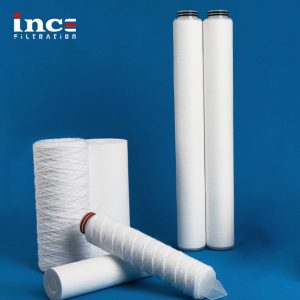
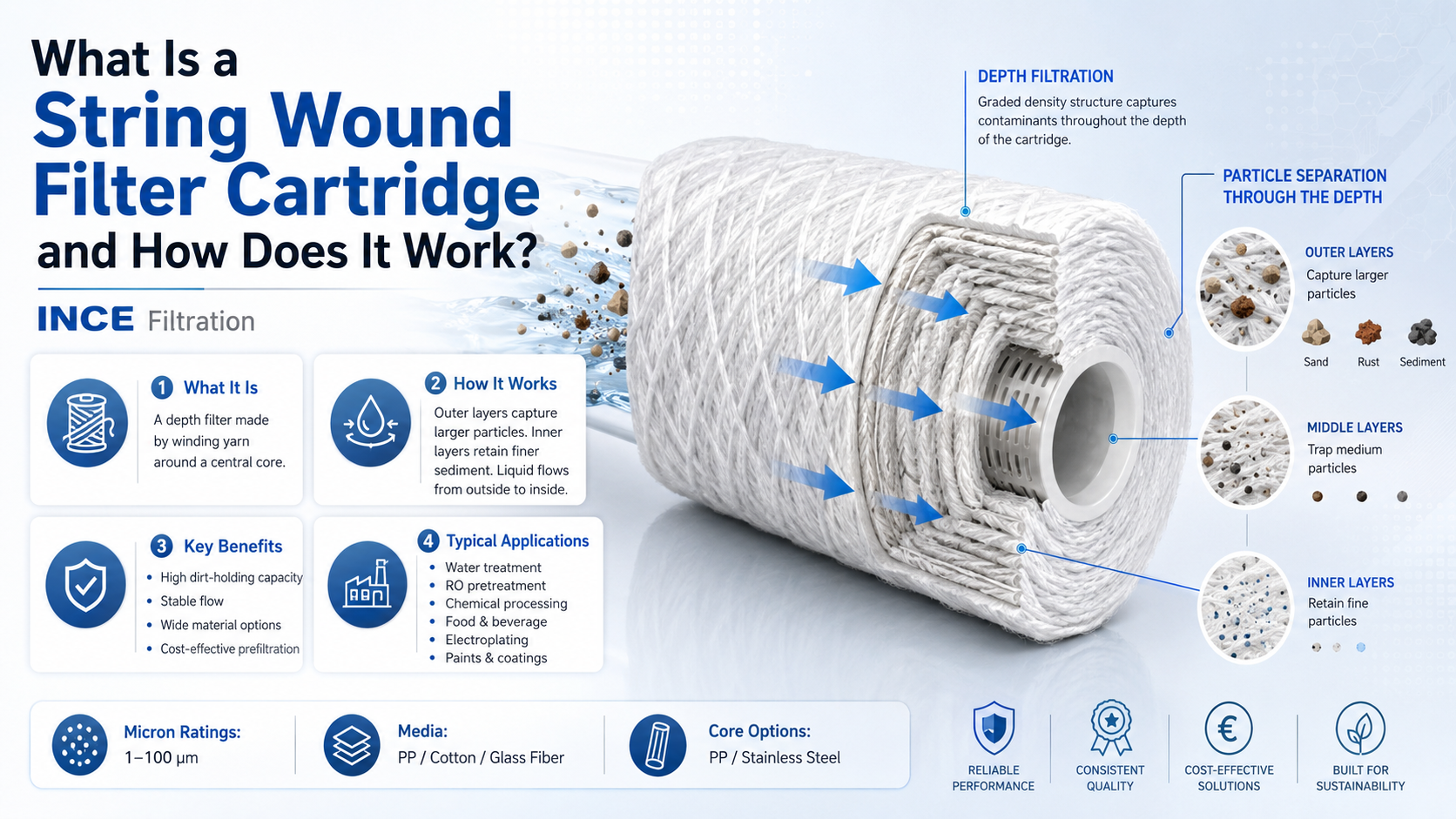
A string wound filter cartridge is a cylindrical depth filter made by winding yarn around a central core. The yarn is wound in a controlled pattern to create a layered structure. As liquid passes from the outside of the cartridge toward the inner core, particles are captured throughout the depth of the filter.
Unlike a surface filter that mainly traps contaminants on the outside layer, a string wound cartridge captures particles in multiple layers. This gives it higher dirt-holding capacity and a longer service life in many sediment-heavy applications.
The winding pattern is not random. High-quality cartridges are manufactured with controlled spacing, tension, and density. This structure helps create a graded filtration path, allowing larger particles to be trapped near the outer layers and finer particles to be captured deeper inside the cartridge. The Cary Company notes that string wound cartridges use diamond-shaped patterns to determine micron ratings and provide depth filtration with high dirt loading capacity.
How Does a String Wound Filter Cartridge Work?
A string wound filter cartridge works through depth filtration. The fluid enters from the outside surface, passes through the wound yarn layers, and exits through the inner core.
The filtration process can be understood in three stages.
1. Outer Layer Captures Larger Particles
The outer layer of the cartridge is usually more open. This allows the liquid to enter easily while capturing larger contaminants such as sand, rust flakes, pipe scale, dirt, and coarse suspended solids.
This first layer prevents large particles from quickly blocking the finer inner layers.
2. Middle Layer Holds Medium Particles
As the liquid moves deeper into the cartridge, the winding structure becomes tighter. Medium-sized particles are trapped in this zone. This is where much of the cartridge’s dirt-holding capacity is used.
Because particles are distributed throughout the depth of the cartridge instead of forming a thick cake on the surface, the cartridge can often maintain flow longer than a basic surface filter.
3. Inner Layer Removes Finer Sediment
The inner layer is denser and provides the final particle retention according to the selected micron rating. After passing through this layer, the filtered liquid exits through the cartridge core and continues downstream.
This graded structure is one of the main reasons string wound cartridges are widely used for sediment filtration. Hydrodex describes this type of design as a diamond weave pattern that creates a graded pore structure and tortuous flow path, helping improve dirt-holding capacity while maintaining low pressure drop.
Why Is It Called a Depth Filter?
A string wound cartridge is called a depth filter because particles are captured inside the filter body, not only on the surface. The liquid travels through a thick filtration path made of wound yarn.
This is important for applications where the feed liquid contains particles of different sizes. A surface filter may clog quickly when exposed to heavy sediment. A depth filter can hold contaminants across multiple layers, which helps extend cartridge life and improve system stability.
United Filters also describes string wound cartridges as true depth filtration products with high dirt-holding capacity and low media migration.
Main Benefits of String Wound Filter Cartridges
High Dirt-Holding Capacity
The layered yarn structure provides a large internal filtration area. This allows the cartridge to hold more contaminants before replacement is required.
For industrial users, this can mean fewer cartridge change-outs, less downtime, and lower maintenance cost.
Stable Flow Performance
A well-made string wound cartridge provides a balanced flow path. The outer layers allow liquid to enter without excessive resistance, while the inner layers provide finer filtration.
This balance helps reduce initial pressure drop and supports stable operation in water treatment and process filtration systems.
Wide Micron Rating Options
String wound cartridges are available in many micron ratings, commonly from 0.5 micron to 200 micron depending on the manufacturer and cartridge design. Hydrodex lists nominal micron ratings from 1 to 200, while Champion Process lists options from 0.5 to 150 micron.
Common micron ratings include:
- 1 micron
- 3 micron
- 5 micron
- 10 micron
- 20 micron
- 25 micron
- 50 micron
- 75 micron
- 100 micron
For RO pretreatment, 5 micron is commonly used. For heavy sediment removal, coarser ratings such as 20, 50, or 100 micron may be more suitable.
Flexible Material Selection
One major advantage of string wound cartridges is the ability to choose different yarn and core materials. This makes them suitable for many liquids, temperatures, and chemical environments.
Common yarn materials include:
- Polypropylene
- Cotton
- Polyester
- Nylon
- Glass fiber
- Rayon
Common core materials include:
- Polypropylene
- Stainless steel
- Tin-plated steel
- Glass-filled polypropylene
Champion Process notes that string wound filters are available in materials such as polypropylene, cotton, polyester, nylon, glass fiber, Ryton, and rayon, making them suitable for a wide variety of filtration environments.
Cost-Effective Filtration
String wound cartridges are often used as economical pre-filters. They help protect pumps, valves, spray nozzles, RO membranes, carbon filters, pleated cartridges, and other downstream equipment.
In many systems, using a string wound cartridge before more expensive fine filtration elements can reduce total operating cost.
Common Applications of String Wound Filter Cartridges
Industrial Water Treatment
Industrial water often contains sand, rust, pipe scale, and suspended solids. String wound cartridges are commonly used to improve water quality before further treatment.
Typical uses include:
- Process water filtration
- Cooling water filtration
- Boiler feed water pretreatment
- Groundwater filtration
- Well water filtration
- Recycled water filtration
Reverse Osmosis Pretreatment
RO membranes are sensitive to suspended particles. If sediment reaches the membrane, it can cause fouling, pressure increase, and reduced system efficiency.
A string wound filter cartridge installed before the RO system helps reduce sediment load and protect the membrane. This is one of the most common applications for 5 micron polypropylene wound cartridges.
Chemical Processing
Chemical plants often need filter cartridges that can handle different pH levels, temperatures, and fluid compositions. With the right yarn and core material, string wound cartridges can be used for acids, alkalis, solvents, plating solutions, and other process liquids.
Material compatibility should always be confirmed before use.
Food and Beverage Processing
String wound cartridges can be used for pre-filtration of process water, ingredient water, syrups, edible oils, and other liquids in suitable food and beverage applications.
For these applications, users should confirm whether the material meets the required food contact or regulatory standards.
Electroplating and Surface Treatment
In plating baths and surface treatment lines, suspended particles can affect coating quality and finish consistency. String wound cartridges help remove contaminants from plating solutions and improve process stability.
Paints, Inks, and Coatings
Particles in paints, inks, and coatings can cause defects, nozzle blockage, and inconsistent finish quality. String wound cartridges are often used as pre-filters to remove unwanted solids before final processing or packaging.
Oil and Petrochemical Filtration
Depending on material compatibility, string wound cartridges may be used for selected oil, petrochemical, and hydrocarbon-related filtration processes. Cotton, polypropylene, glass fiber, or other media may be selected according to fluid type and temperature.
Technical Structure of a String Wound Filter Cartridge
A typical string wound cartridge includes three main parts.
Filter Yarn
The yarn is the main filtration medium. It determines chemical compatibility, temperature resistance, particle retention, and dirt-holding performance.
Polypropylene is widely used because it offers good chemical resistance and is suitable for many water and chemical filtration applications. Cotton may be selected for specific oil or higher-temperature uses. Glass fiber can be used where higher temperature or chemical resistance is required.
Inner Core
The core supports the cartridge structure and allows filtered liquid to exit. The core must be strong enough to resist pressure and compatible with the process liquid.
Polypropylene cores are common in general water filtration. Stainless steel cores may be used for higher temperature, higher pressure, or more demanding chemical environments.
End Configuration
String wound cartridges can be supplied with different end styles to match filter housings.
Common options include:
- DOE: Double Open End
- SOE: Single Open End
- 222 adapter
- 226 adapter
- Flat gasket
- Fin end
- Spring end
Correct end configuration is important because poor sealing can cause bypass, allowing unfiltered liquid to pass downstream.
How to Choose the Right String Wound Filter Cartridge
Choose the Right Micron Rating
The micron rating should match the particle size you need to remove. A cartridge that is too coarse may not protect downstream equipment. A cartridge that is too fine may clog too quickly.
For example:
- 50–100 micron: coarse sediment removal
- 20–25 micron: general pre-filtration
- 5–10 micron: finer sediment control
- 1–3 micron: fine particle removal before sensitive equipment
Confirm Chemical Compatibility
Always match the yarn, core, gasket, and end-cap materials to the liquid being filtered. Chemical incompatibility can cause swelling, softening, cracking, or cartridge failure.
Check Temperature and Pressure Conditions
Different materials have different temperature limits. If the liquid is hot or the operating pressure is high, the core and yarn selection become especially important.
Match Cartridge Size
Standard cartridge lengths include:
- 10 inches
- 20 inches
- 30 inches
- 40 inches
Other lengths are also available depending on the housing and manufacturer. Hydrodex lists cartridge lengths from 10 to 70 inches, showing that longer cartridges are commonly used in industrial systems.
Consider Dirt Load and Flow Rate
If the liquid contains a high sediment load, a larger cartridge, coarser pre-filter, or multi-cartridge housing may be needed. High-flow systems require careful sizing to prevent excessive pressure drop.
String Wound Filter Cartridge vs. Melt Blown Cartridge
Both string wound and melt blown cartridges are used for sediment filtration, but they are not the same.
A string wound cartridge is made by winding yarn around a core. It offers strong depth filtration, flexible material options, and good performance in applications with heavy or mixed particle loads.
A melt blown cartridge is usually made from thermally bonded polypropylene fibers. It is widely used for general water filtration and clean liquid applications.
Choose a string wound cartridge when you need:
- Higher dirt-holding capacity
- More material options
- Better performance with mixed particle sizes
- Compatibility with special liquids
- Industrial process flexibility
Choose a melt blown cartridge when you need:
- Simple sediment filtration
- All-polypropylene construction
- Cost-effective replacement
- General water treatment use
Why Choose INCE Filtration?
INCE Filtration provides string wound filter cartridges for industrial users, OEM equipment manufacturers, distributors, and water treatment companies. Our cartridges are designed to help customers achieve stable filtration performance, reduce maintenance problems, and protect downstream equipment.
We offer:
- Multiple micron ratings
- Polypropylene, cotton, polyester, nylon, and glass fiber options
- Polypropylene, stainless steel, and other core materials
- Standard and customized lengths
- DOE, SOE, 222, 226, fin, spring, and gasket end styles
- Support for OEM and bulk orders
- Application-based product recommendations
At INCE Filtration, we understand that filtration performance depends on more than just a micron rating. Liquid type, temperature, pressure, flow rate, particle load, housing design, and replacement schedule all matter. That is why we help customers choose the cartridge that fits their real operating conditions.
Frequently Asked Questions
What does a string wound filter cartridge remove?
It removes suspended solids such as sand, rust, dirt, scale, silt, metal particles, and other sediment from liquid streams.
Is a string wound filter cartridge washable?
Most string wound cartridges are designed as disposable elements. Rinsing may remove some surface dirt, but it usually cannot restore the internal depth filtration capacity.
What is the best micron rating for water filtration?
For general sediment filtration, 5 micron, 10 micron, and 20 micron are commonly used. For RO pretreatment, 5 micron is often selected. For heavy sediment, a coarser cartridge may be better as the first filtration stage.
How do I know when to replace the cartridge?
Replace the cartridge when pressure drop increases, flow rate decreases, product quality drops, or the cartridge reaches the recommended service interval.
Can INCE Filtration customize string wound cartridges?
Yes. INCE Filtration can customize micron rating, length, diameter, media material, core material, and end configuration according to your system requirements.
Contact INCE Filtration for String Wound Filter Cartridges
A string wound filter cartridge is a simple but highly effective solution for sediment removal and process filtration. With its depth filtration structure, high dirt-holding capacity, flexible material selection, and economical replacement cost, it remains a trusted choice across water treatment and industrial applications.
Looking for a reliable string wound filter cartridge supplier?
Contact INCE Filtration today to discuss your filtration conditions, request technical specifications, or get a quotation for standard and customized string wound filter cartridges. Our team will help you select the right cartridge for your application, flow rate, liquid type, and filtration target.
TAGs: pleated liquid filter cartridges china 5 micron filter wholesaler how to choose industrial filter bags 0.22 Micron Pleated Filter Cartridges industrial liquid filter bags Polyester Felt Liquid Filter Bag Pleated Filter Cartridge Manufacturer Pleated Filter Cartridge Factory Pleated Liquid Filter Cartridges How to Choose a Reliable Pleated Filter Cartridge Manufacturer Pleated Liquid Filter Cartridges pleated membrane cartridgesRelated Posts