The Definitive Guide to 5 Micron Liquid Filter Bags: Optimizing Purity and Process Flow in 2026
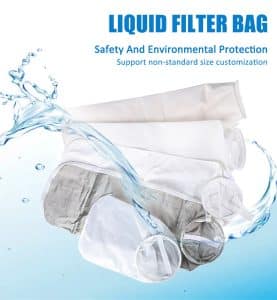
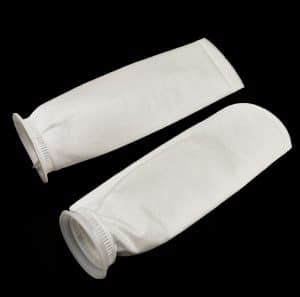
In industrial processing, the 5 micron liquid filter bag is the industry’s “strategic middle ground.” It is fine enough to capture microscopic sediment, silt, and yeast, yet robust enough to maintain the high flow rates required for 24/7 manufacturing cycles. Whether you are refining chemicals, processing beverages, or managing automotive e-coatings, selecting the correct 5-micron media is a critical decision that impacts both product quality and system longevity.
As global quality standards become more stringent, understanding the science behind the 5 micron liquid filter bag is essential for any facility aiming to reduce waste and maximize ROI.
1. Defining the 5-Micron Standard: The Science of Retention
A “micron” ($\mu m$) is one-millionth of a meter. To understand the precision of a 5 micron liquid filter bag, consider that a human red blood cell is approximately $8 \mu m$. By filtering at 5 microns, you are operating at a sub-cellular level of clarity.
Nominal vs. Absolute Efficiency
When sourcing 5 micron liquid filter bags wholesale, the most expensive mistake is confusing nominal and absolute ratings:
-
Nominal Rating: Indicates that the bag will trap approximately 60% to 80% of particles 5 microns or larger. This is ideal for high-solids applications and pre-filtration.
-
Absolute Rating: Utilizes multi-layered “graded density” media to achieve 99% or higher retention. This is mandatory for pharmaceutical and microelectronics applications.
2. Media Selection: Why Material Chemistry Dictates Success
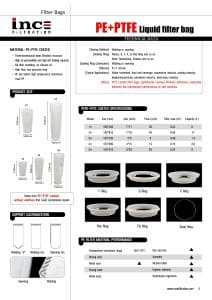
The performance of a 5 micron liquid filter bag is tied to its polymer composition. In 2026, the three dominant materials serve distinct chemical environments.
A. Polypropylene (PP) Felt – The Versatile Workhorse
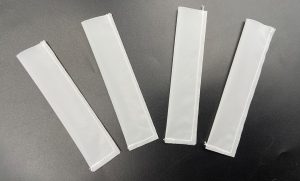
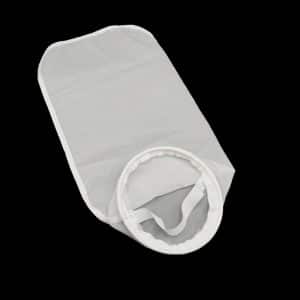
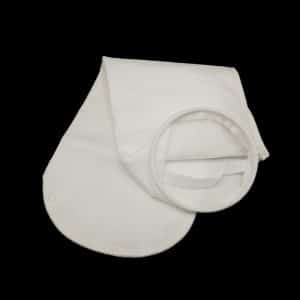
Polypropylene is the most common material for 5 micron liquid filter bags. It is naturally hydrophilic and possesses excellent resistance to both acids and alkalis.
-
Optimal Temperature: Up to $90^{\circ}C$ ($194^{\circ}F$).
-
Key Advantage: Lowest extractable levels, making it the standard for FDA-compliant food and beverage processes.
B. Polyester (PE) Felt – The High-Heat Specialist
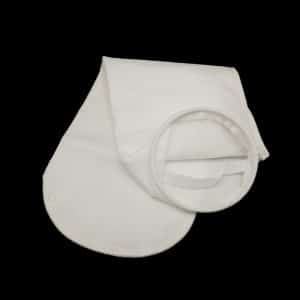
When your process fluid exceeds $100^{\circ}C$, polyester becomes the media of choice.
-
Optimal Temperature: Up to $150^{\circ}C$ ($302^{\circ}F$).
-
Key Advantage: Superior tensile strength and resistance to oxidizing agents and most petroleum-based solvents.
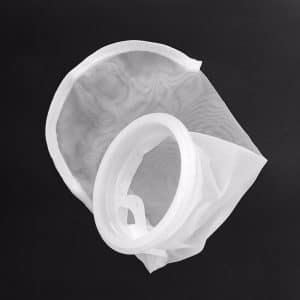
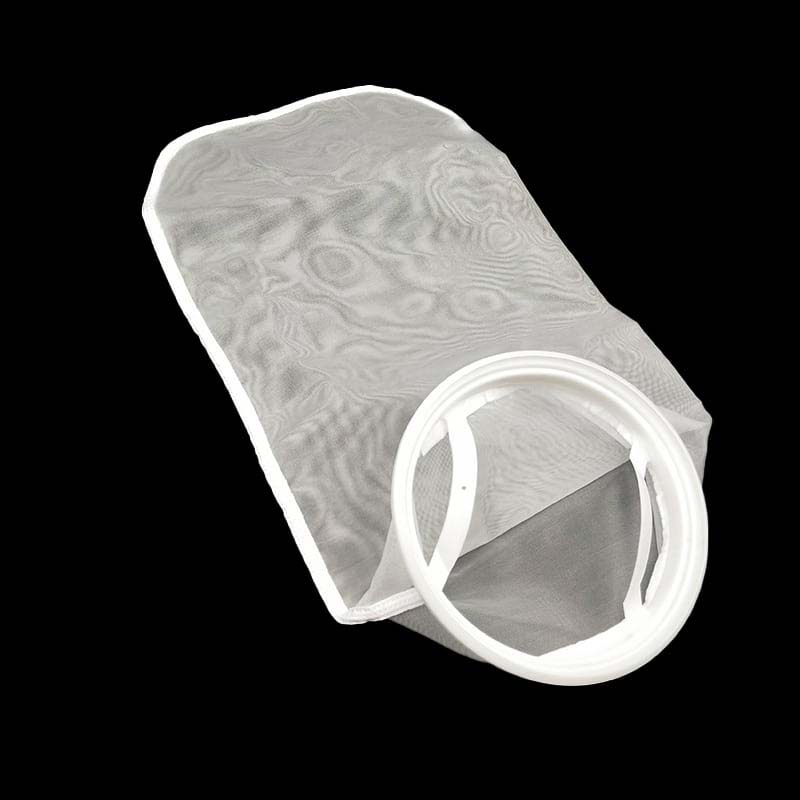
C. Nylon Monofilament (NMO) – Precision Surface Filtration
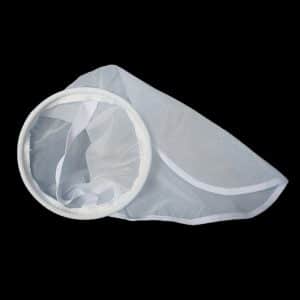
Unlike felt, which traps dirt within its thickness (depth filtration), nylon monofilament uses a fixed-grid weave to trap particles on the surface.
-
Key Advantage: Highly precise pore size, zero fiber migration, and the ability to be washed and reused in non-critical applications.
3. Engineering the Flow: The Physics of Pressure Drop ($\Delta P$)
A common technical query involves the “Clean Pressure Drop.” Every 5 micron liquid filter bag introduces resistance into the system. Understanding the relationship between flow rate ($Q$) and pressure differential ($\Delta P$) is key to pump efficiency.
Using a simplified version of the Ergun equation for porous media:
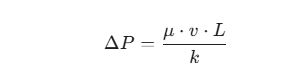
(Where µ is fluid viscosity, is flow velocity, L is media thickness, and k is the permeabilityconstant of the 5-micron fabric.)
Procurement Insight: By choosing a 5 micron liquid filter bag with a higher “open area” or a larger surface area (e.g., transitioning from a Size #1 to a Size #2 bag), you can lower the initial $\Delta P$, effectively doubling the dirt-holding capacity and reducing the frequency of bag changes.
4. Construction Standards: Welded vs. Sewn Seams
In the 2026 market, the “Sewn Bag” is being rapidly phased out of high-precision environments in favor of fully welded construction.
The Bypass Risk
In a sewn 5 micron liquid filter bag, the needle creates holes ranging from $100$ to $300$ microns. In a 5-micron application, these holes act as “highways” for contaminants.
-
Welded Advantage: Ultrasonic or thermal welding fuses the fabric at a molecular level. This creates a $100\%$ leak-proof seal, ensuring that no particle larger than 5 microns bypasses the media.
-
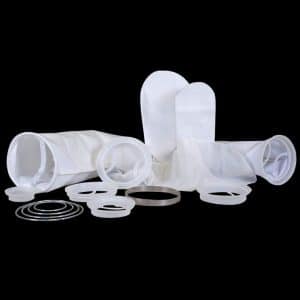
The Plastic Collar: Professional bags now feature molded plastic “SDS” or “Sentinel” seals that snap into the filter housing, creating a redundant pressure-activated seal.
5. Critical Applications: Where 5-Micron Precision is Non-Negotiable
I. Pharmaceutical and Biotech Pre-filtration
Before fluids reach expensive $0.22 \mu m$ membrane filters, they are passed through a 5 micron liquid filter bag. This “sacrificial” filtration layer removes the bulk of the particulate load, extending the life of the final membrane by up to $500\%$.
II. Automotive E-Coat and Paint Finishes
In automotive assembly, “fish-eyes” and surface defects are often caused by microscopic debris in the paint line. A 5-micron nylon monofilament bag ensures a mirror-like finish by eliminating particulates that are invisible to the naked eye but catastrophic to the coating process.
III. Food and Beverage Clarification
From maple syrup to craft beer, the 5 micron liquid filter bag provides the final “polish.” It removes residual yeast and fine sediments while allowing the essential flavor oils and proteins to pass through, ensuring product brilliance without compromising taste profile.
6. Operation and Maintenance: The 15 PSI Rule
Managing a 5 micron liquid filter bag system requires a proactive change-out strategy. Operating a bag until it ruptures is a leading cause of downstream equipment damage.
-
Baseline Pressure: Record the pressure gauge reading upon installation of a clean bag.
-
Terminal Pressure: Once the differential pressure ($\Delta P$) reaches $15 \text{ to } 20 \text{ PSI}$, the bag has reached its dirt-holding limit.
-
The Danger Zone: Beyond $25 \text{ PSI}$, “particle bypass” or “strike-through” can occur, where the high pressure actually forces trapped contaminants through the media fibers.
7. ROI and Procurement Strategy: Sourcing Wholesale
When evaluating the cost of a 5 micron liquid filter bag, professional buyers look at the “Cost per Gallon Filtered” rather than the “Price per Bag.”
-
Extended Life Cycles: Premium graded-density bags may cost $20\%$ more but can hold $2\times$ more dirt, resulting in $40\%$ lower annual filtration costs.
-
Downstream Protection: High-quality 5-micron bags protect sensitive equipment like high-pressure spray nozzles and HPLC columns, preventing thousands of dollars in maintenance downtime.
-
Inventory Consolidation: Because 5 microns is a “universal” size for both pre-filtration and final-polishing, many facilities consolidate their inventory to this single micron rating to leverage bulk wholesale pricing.
8. FAQ: Frequently Asked Questions
Q: Can a 5 micron liquid filter bag remove oil from water?
A: Standard felt bags will remove some suspended oil droplets, but for efficient oil removal, you should use a specialized oil-adsorbing 5-micron bag made from melt-blown polypropylene microfiber.
Q: Is 5 micron fine enough for drinking water?
A: It is excellent for removing sediment, sand, and large cysts (like Giardia), but it is not a “purifier.” For microbiological safety, 5-micron filtration must be followed by UV sterilization or sub-micron membrane filtration.
Q: What is the flow rate of a Size #2 5-micron bag?
A: For water-like viscosity, a standard Size #2 bag can typically handle up to $80 \text{ to } 100 \text{ GPM}$ depending on the media type and housing configuration.
Conclusion: The Backbone of Industrial Purity
The 5 micron liquid filter bag is the silent guardian of the modern production line. By balancing technical precision with operational durability, it allows industries to meet the rigorous demands of the 2026 global market. Whether you are aiming for FDA compliance or simply trying to extend the life of your downstream equipment, investing in high-quality, welded 5-micron filtration is a strategic move for any process engineer.
Are you ready to optimize your filtration efficiency? Our 2026 series of 5 micron liquid filter bags features the latest in ultrasonic welding and multi-layer depth media. Contact our engineering team for a technical audit of your system and a wholesale quotation.
[Request a Wholesale Quote] | [Download the 2026 Chemical Compatibility Chart] | [Order a Performance Sample]
TAGs: pleated liquid filter cartridges china 5 micron filter wholesaler how to choose industrial filter bags 0.22 Micron Pleated Filter Cartridges industrial liquid filter bags Polyester Felt Liquid Filter Bag Pleated Filter Cartridge Manufacturer Pleated Filter Cartridge Factory Pleated Liquid Filter Cartridges How to Choose a Reliable Pleated Filter Cartridge Manufacturer Pleated Liquid Filter Cartridges pleated membrane cartridgesRelated Posts